

Shopify Acquires Tailwind Labs to Secure the CSS Framework: A Deep Dive for Developers
In a move that sent ripples through the frontend development community, Shopify officially acquired Tailwind Labs on September 9, 2026. The same day, Tailwind Plus, the commercial offering that provided pre-built components and templates, stopped accepting new customers. Tailwind CSS, the open-source utility-first framework loved by millions, remains free and MIT-licensed. But the acquisition raises critical questions: Why did Shopify make this move? How will it affect the framework’s future? And what does it mean for the thousands of developers who rely on Tailwind CSS daily?
This acquisition isn’t just another tech headline. It’s a strategic consolidation that underscores the growing importance of design systems in e-commerce and beyond. Let’s unpack the details, analyze the business logic, and explore what comes next for the framework that redefined modern CSS.
What Happened: The Acquisition Deal Details
On September 9, 2026, Shopify announced that Tailwind Labs was joining its engineering organization. The deal was immediate and decisive: Tailwind Plus, the paid tier that offered UI kits, components, and priority support, was shut down for new subscribers on the same day. Existing customers retained access for the remainder of their subscription period, but no new sign-ups were accepted. Tailwind CSS, the framework’s core open-source project, remains untouched and continues under its MIT license, ensuring that the millions of developers using it can do so without interruption.
Key figures from both sides were swift to reassure the community. Adam Wathan, creator of Tailwind CSS, emphasized that the framework’s development would actually accelerate under Shopify’s umbrella. “We’re joining a company that not only values open source but has built its entire platform around it,” he noted. Shopify’s CTO echoed that sentiment, citing the need to “secure the foundational CSS layer for the modern web.”
While exact financial terms weren’t disclosed, industry analysts estimate the deal value to be in the mid-nine-figure range, reflecting both the framework’s ubiquity and the strategic necessity for Shopify. The acquisition comes at a time when the CSS framework landscape is undergoing rapid transformation, driven by AI-powered code generation and a shift toward utility-first styling.
Tailwind CSS: From Side Project to Industry Standard
To appreciate the acquisition, you need to understand how Tailwind CSS rose to dominance. Launched in 2017, it introduced a radical approach: instead of pre-designed components, it provides low-level utility classes that let developers compose designs directly in HTML. This “utility-first” methodology was initially controversial, but it soon won over developers tired of fighting against opinionated frameworks.

The numbers tell a compelling story. From a modest beginning, Tailwind CSS now clocks over 4.2 million weekly npm downloads, making it the most installed CSS framework, surpassing even Bootstrap in certain metrics. Its growth has been meteoric, as the chart below illustrates.
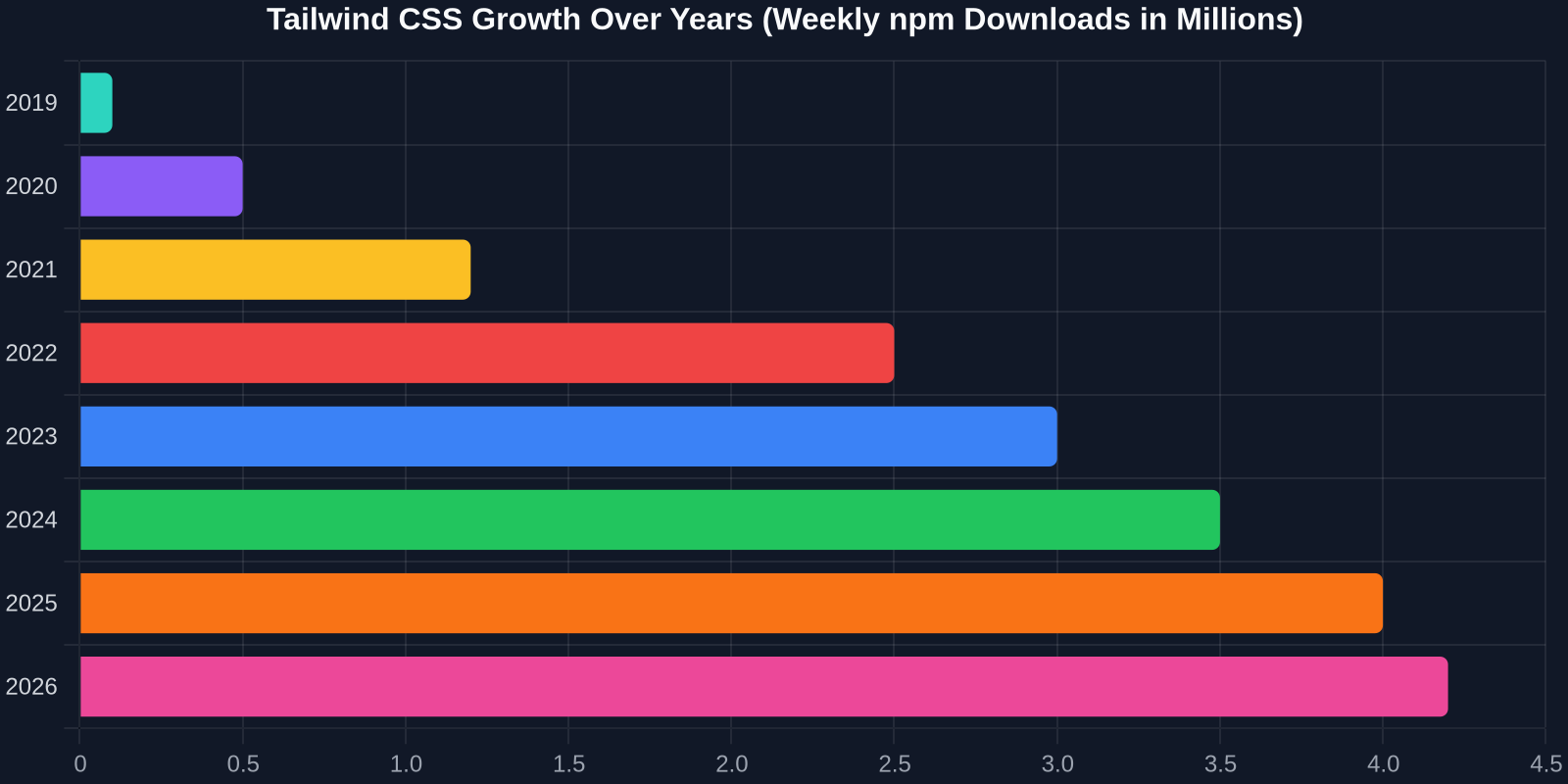
This growth wasn’t accidental. Tailwind CSS solved real pain points: specificity wars, naming conventions, and bloated stylesheets. By using functional classes like flex, pt-4, or text-center, developers could build responsive interfaces faster without ever leaving the HTML. Combined with a purging system that eliminates unused CSS in production, the framework delivered both developer experience and performance.
The ecosystem around Tailwind CSS flourished, official UI libraries, community plugins, editor integrations, and comprehensive documentation. Tailwind Plus, launched as a way to sustain development, offered premium components and templates. But as we’ll see, a new technological wave began to undermine that business model.
Why Shopify Acquired Tailwind Labs
For Shopify, the acquisition is a defensive and offensive play rolled into one. On the surface, it’s about securing the technology that powers a significant portion of Shopify theme development. Over the past few years, Tailwind CSS has become the de facto styling choice for many Shopify themes and custom storefronts built with Hydrogen (Shopify’s React-based framework). By bringing the framework’s creators in-house, Shopify ensures it has deep expertise and control over a critical piece of its developer toolchain.
"Shopify's acquisition of Tailwind Labs ensures that the company can steer the CSS framework that underpins millions of merchant storefronts, without any risk of it drifting into competitor hands."
But there’s a broader strategy at work. Shopify is competing in an e-commerce landscape where user experience increasingly defines conversion rates. A fast, visually consistent, and easily customizable design system is a competitive advantage. By embedding Tailwind CSS deeply into its platform, Shopify can offer merchants and developers a seamless way to build beautiful storefronts while maintaining high performance.
Additionally, acquiring Tailwind Labs gives Shopify direct influence over the future of a framework that many headless commerce setups rely on. In an era where composable commerce is gaining traction, owning the most popular CSS toolkit strengthens Shopify’s position as the platform that bridges commerce and modern web development.
The AI Factor: How Code Generators Disrupted Tailwind Plus
One of the most fascinating subplots of this story is how artificial intelligence reshaped the economic model behind Tailwind Labs. When Tailwind Plus was introduced, it offered a clear value proposition: save time by using pre-built, professionally designed components that adhere to Tailwind’s utility-first system. But as AI-assisted coding tools like GitHub Copilot, Cursor, and even ChatGPT became proficient at generating Tailwind CSS code on demand, that value proposition eroded.

Developers found that they could simply describe a UI element in natural language, and the AI would spit out perfectly formatted Tailwind HTML in seconds. Need a card component with a gradient background and responsive grid? Just ask. Suddenly, paying for a component library seemed less compelling when AI could generate bespoke code for free, with the same level of quality and customization.
This phenomenon wasn’t limited to Tailwind Plus; it impacted all commercial component libraries. But Tailwind’s syntax, concise, highly repetitive, and pattern-based, was particularly easy for large language models to learn. The result was a collapse in demand for the paid offering. As insiders hinted, “AI tools devastated Tailwind Labs’ business model by enabling developers to generate Tailwind CSS code on demand, collapsing demand for the company's paid products.” The acquisition by Shopify provided a graceful exit and a way to sustain the open-source project indefinitely.
Impact on the Tailwind Ecosystem
For the vast majority of developers who use the free, open-source version of Tailwind CSS, the immediate impact is negligible. The project remains MIT-licensed, and the core team continues to work on it. In fact, with Shopify’s resources, the framework may see more frequent updates, better integration with Shopify tools, and expanded educational content. The community has largely reacted positively, viewing Shopify as a stable steward that won’t abruptly monetize the framework.
However, the shutdown of Tailwind Plus leaves a gap for developers who relied on official premium components. Alternatives exist: community-built libraries such as Tailwind UI (the permissive free tier still exists), Flowbite, and DaisyUI remain available. But the official, curated premium experience is gone. This may accelerate the development of open-sourced component collections or push more developers toward AI-generated solutions.
What This Means for Frontend Developers
The acquisition sends several signals to frontend developers:

- Utility-first CSS is here to stay. Shopify’s investment validates the approach. If you’ve been hesitant to adopt Tailwind CSS, now is the time to learn it. It’s a safe, long-term skill.
- Open source can thrive under corporate stewardship. When done right, corporate backing provides resources without sacrificing community principles. The MIT license remains inviolate.
- AI is reshaping the tools we use. The disruption to Tailwind Plus is a microcosm of a larger trend: AI code generation is commoditizing certain developer tools. Developers who embrace AI alongside frameworks will be the most productive.
- Shopify’s ecosystem is becoming even more attractive. If you build on Shopify, the acquisition means a tighter integration between Hydrogen, Liquid, and the styling layer, likely resulting in faster development cycles and better documentation.
"The acquisition isn’t about locking anyone in, it’s about making sure the open web has a solid CSS foundation that doesn’t get fragmented or abandoned."
Comparing CSS Frameworks in a Post-Acquisition World
To understand why Shopify chose Tailwind CSS, it helps to compare it with other major frameworks. The table below highlights key differences in approach, customization, learning curve, and performance.
As the comparison shows, Tailwind CSS excels in customization and performance, two factors critical for e-commerce sites where every kilobyte matters and brand identity must be precisely controlled. Shopify’s decision makes perfect technical sense.
The Future of CSS Frameworks and Shopify’s Bet
Looking ahead, we can expect several developments:
- Deeper integration with Shopify Hydrogen. Tailwind CSS will likely become the default styling engine for Hydrogen storefronts, with official presets and easy setup.
- Improved performance tooling. Shopify may invest in better build-time optimization, possibly integrating directly with Oxygen (Shopify’s hosting) for edge-cached, purged CSS.
- Community growth. With financial uncertainty removed, the Tailwind CSS community can focus on innovation rather than fundraising. Expect more plugins, themes, and educational content.
- AI augmentation. Shopify might build its own AI-powered tools that generate Tailwind-based components specifically for commerce, combining the best of both worlds.
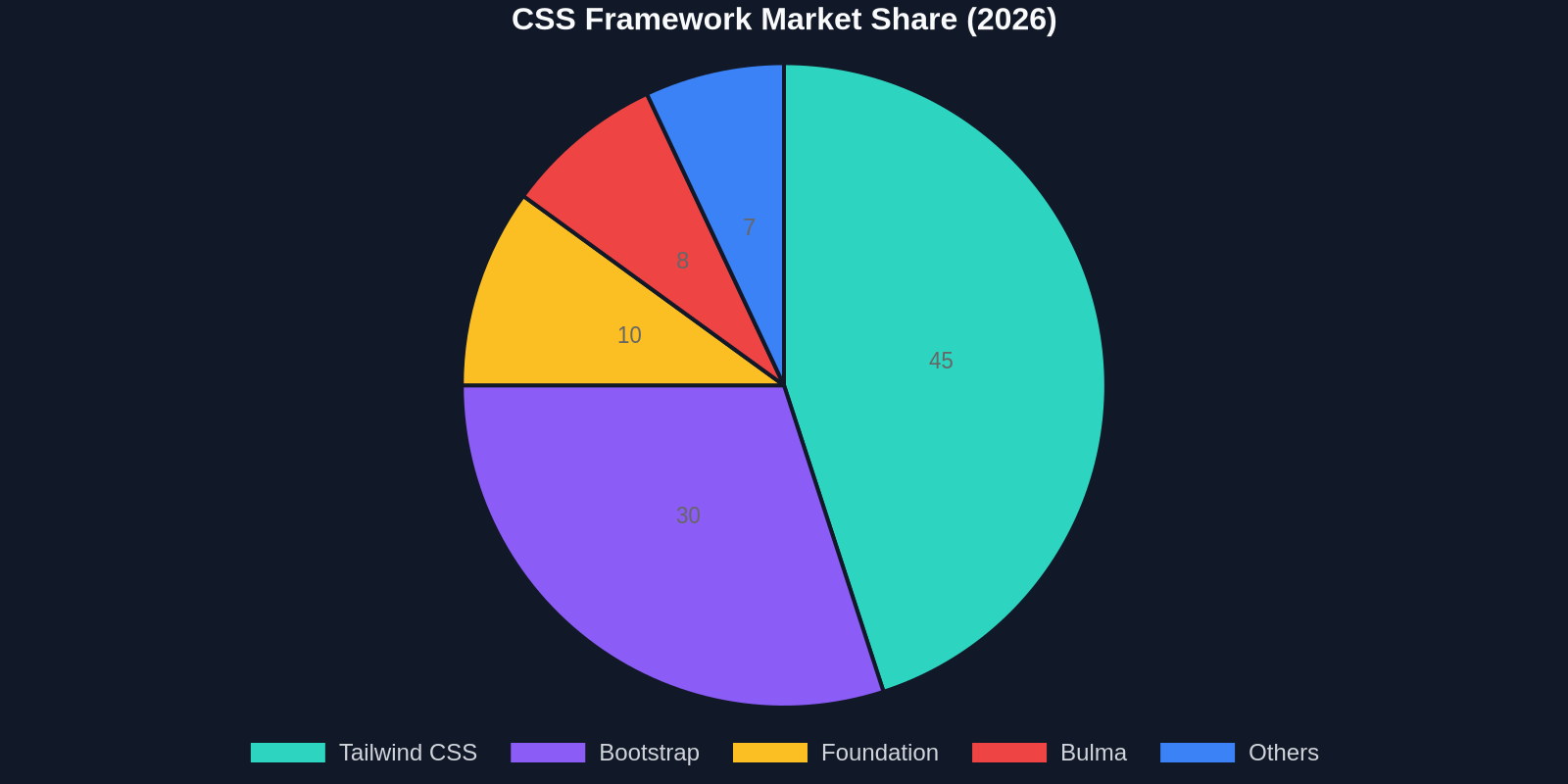
The market share data above shows Tailwind CSS commanding a dominant position. With Shopify’s backing, that lead is likely to extend even further. But the landscape is dynamic: new frameworks like Panda CSS and StyleX are exploring compile-time CSS approaches, and AI may eventually change how we write styles altogether. Still, Tailwind’s utility-first philosophy has proven remarkably resilient, and Shopify’s acquisition cements its place in the frontend toolkit.
Conclusion: A Win for Developers and Open Source
Shopify’s acquisition of Tailwind Labs is a textbook case of strategic open-source consolidation. It protects a critical piece of web infrastructure, ensures ongoing investment, and aligns the interests of a major platform with the developer community. For everyday developers, nothing breaks, your tailwind.config.js still works, your classes still compile, and your projects are safe.
The only real casualty is Tailwind Plus, a business model that was already being disrupted by AI. For those who need premium components, the ecosystem offers plenty of free, high-quality alternatives. Meanwhile, Shopify gains a competitive advantage by owning the styling layer that will power the next generation of commerce experiences.
If you work with CSS, now is an excellent time to deepen your Tailwind skills. The framework isn’t just surviving; it’s poised to thrive under one of the most influential tech companies in the e-commerce space. The future of CSS is utility-first, and Shopify just ensured it stays open and innovative.